Ticket Broking Masterclass
A beginner path for US and Canada brokers. Start with the fee math that decides whether a buy is worth it — then work through presales, resale checks, and the daily routine before you risk real money.
Free forever · No payment required · Beginner lessons first
Seven chapters. One clear learning path.
Start with Chapter 1 and work forward. Learn the business, check the numbers and rules, understand selling and presales, then practice reviewing an event.
01Foundation2 lessons · 38 min
By the end: Explain how a ticket resale works and write a realistic first-month plan.
02Money math4 lessons · 26 min
By the end: Calculate break-even, set a spending limit, and account for delayed payouts.
- Lesson 03Ticket resale fees explainedSeller deductions, buyer fees, acquisition cost, payout math.7 MIN
- Lesson 04Ticket resale profit calculatorEstimate profit, loss, and break-even price before buying.5 MIN
- Lesson 05How to price resale ticketsCompare nearby inventory and set a realistic objective.8 MIN
- Lesson 06Ticket resale payout timesWhy cash flow matters when money is tied up until after the event.6 MIN
03Trust & rules5 lessons · 31 min
By the end: Identify the local rules and ticket restrictions you must verify before buying.
- Lesson 07Is ticket reselling legal?Federal bot rules, state variation, venue terms, safer habits.7 MIN
- Lesson 08Ticket resale laws in CanadaProvince checks, price display, transfer rules.6 MIN
- Lesson 09Ticket broker taxes explained1099-K, gross sales, cost basis, fees, records.7 MIN
- Lesson 10The BOTS Act explainedWhat to avoid, and how research differs from circumvention.5 MIN
- Lesson 11Do you need a license?Licensing, registration, marketplace verification.6 MIN
04Marketplace selling6 lessons · 45 min
By the end: Choose an eligible marketplace and describe how you will deliver tickets.
- Lesson 12Best ticket resale sites for sellersWhere brokers list and what each marketplace changes.8 MIN
- Lesson 13How to sell tickets on StubHubListing, payout, seller fee, delivery, pricing habits.7 MIN
- Lesson 14Vivid Seats seller guideSeller support, listing workflow, delivery steps.7 MIN
- Lesson 15SeatGeek seller guideEligibility, Sell-button checks, fulfillment, payout setup.7 MIN
- Lesson 16Ticketmaster fan-to-fan resaleEligibility, Face Value Exchange, transfer limits.8 MIN
- Lesson 17StubHub vs Vivid Seats for sellersWorkflow, payout, support, and broker use cases.8 MIN
05Presales6 lessons · 43 min
By the end: Find an official presale, verify access, and prepare without bypassing ticket limits.
- Lesson 18Ticket presales for beginnersFan club, venue, cardmember, artist, and verified presale basics.7 MIN
- Lesson 19How to find presale codesWhere codes come from and how to verify access routes.8 MIN
- Lesson 20Presale password trackerKeep codes, access routes, and official links tied to the event.6 MIN
- Lesson 21Ticketmaster presales for brokersOfficial links, queue timing, access types, event context.8 MIN
- Lesson 22AXS presales for brokersAXS offer access, event links, workflow differences.7 MIN
- Lesson 23Ticketmaster vs AXS presalesCompare platform behavior so you know what to expect.7 MIN
06Daily routine3 lessons · 24 min
By the end: Build a daily shortlist and explain why you would buy, watch, or pass on a show.
- Lesson 24Ticket presale calendar for brokersPlan upcoming dates, windows, platforms, official links.8 MIN
- Lesson 25Concert presale calendar for brokersArtist tours, city demand, venue context, concert queues.8 MIN
- Lesson 26Ticket broker toolsThe accounts, tracking, and research tools beginners need.8 MIN
07Use DTR1 lessons · 7 min
By the end: Review one event on paper using price, fees, supply, restrictions, and an exit plan.
Finish with a practice review
Pick one event in the Guided Preview. You do not need to buy a ticket to complete the course.
- Record the official event date, venue, ticket price, fees, and restrictions.
- Calculate a break-even resale price and the loss if your expected price does not hold.
- Check competing dates, available inventory, transfer eligibility, and payout timing.
- Write a buy, watch, or pass decision with a spending limit and an exit plan.
Brand new? Read one of these first
Three short guides that answer the questions most first-time resellers search before anything else.
A worked example, not a forecast
These prices and fees are illustrative. Replace them with verified numbers for the ticket and marketplace you are researching.
Roughly a 44% return. Notice the fees on both ends. An event that only sells at face on the secondary market puts you at a loss — which is why "it'll probably sell" is not a strategy.
Four things to understand first
1. What ticket reselling actually is
Ticket reselling — also called ticket flipping or ticket brokering — is buying event tickets at or near face value, then reselling them on the secondary market for a profit. Brokers work across concerts, sports, theater, and comedy in the US and Canada.
The model is simple in theory: buy low during a presale or onsale, sell high when demand peaks. The difficulty is knowing which events will actually appreciate — and that's where most newcomers lose money.
Not every event is profitable. A large share of presales sell below face on the secondary market. Knowing which is which is the entire skill.
2. How presales work
A presale is an early window where tickets sell before the general public onsale — usually through a code from an artist fan club, credit card partner, venue, or promoter. Presales matter because they're often the only chance to buy desirable inventory at face value before bots and the public clear it out.
The main channels are Ticketmaster (largest primary marketplace in North America), AXS (many venues and tours, especially West Coast), artist and fan club presales with codes for verified fans, and credit card presales from partners like Amex and Capital One.
Presales typically open mid-morning Eastern. Knowing the exact time — and being ready before the queue forms — is a core broker habit.
Go deeper in Stage 5: Presales →3. Spotting a profitable event
The signals aren't mysterious. Tracking them across hundreds of daily presales by hand is what's impractical. Experienced brokers watch:
- Artist demand trajectory — is the act trending up, selling out other dates, getting buzz?
- Venue size vs. demand — a high-demand act in a small club creates scarcity; a stadium may not.
- Presale exclusivity — limited access means less competition at face value.
- Existing secondary prices — if comparable dates are already above face, demand is real.
- Tour history — how did this artist's previous tours perform on resale?
4. The mistakes that sink new brokers
- Buying everything. Newbies chase volume. Pros are selective. One good flip beats five break-even buys.
- Ignoring fees. Both platforms take a cut. Margins that look fine on paper vanish after fees.
- Over-committing on one event. Ten pairs of an unproven act leaves you holding inventory you can't move.
- Chasing hype without data. Social buzz doesn't always translate to resale demand.
- No exit plan. Know where and when you'll list before you buy.
Calculate break-even using the actual seller fee and your all-in purchase cost. An asking price is not a completed sale; test a lower-price scenario and decide how much loss you could accept.
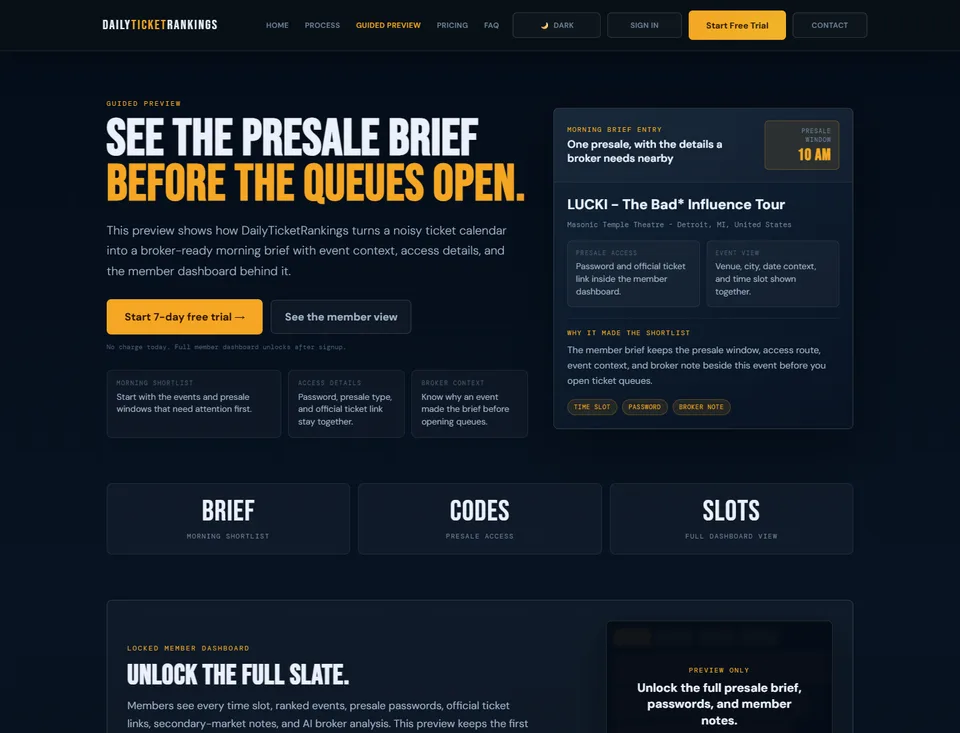
One brief, sorted before the queues open
DTR scores every daily presale and sorts it into tiers, so you know what deserves review first — and what can wait.
Focus first — strongest demand signals, worth reviewing before the queue opens.
Review next — solid demand context, with details to check before acting.
Keep watch — selective review only; compare resale context first.
Later — lighter signals or higher uncertainty. Usually not where to spend time.
Each event carries its presale window, access details, official Ticketmaster and AXS links, resale context, and a short review note — in one place, before 6AM ET.
Get the bootcamp in your inbox
Short daily lessons on how the ticket business works, where beginners lose money, how presales run, and how to build a cleaner morning routine. Five introductory emails to support the full 27-lesson course above.
Free forever · Unsubscribe anytime · No payment required
Common first questions
Is ticket reselling legal in the US and Canada?▾
Reselling is legal in most US states and Canadian provinces, though some have specific rules on pricing, licensing, registration, transfer limits, or marketplace terms.
How much money do I need to start?▾
You can start small — even a few hundred dollars to test the process on one or two well-chosen events. Start with a paper exercise, then set a limit you can afford to lose before considering any purchase.
How do I know which presale to buy?▾
Look at artist demand, venue scarcity, presale exclusivity, and existing secondary prices. DTR organizes these into a daily brief so you don't research each event by hand.
What's a realistic profit per event?▾
It varies widely. There is no dependable profit per event. Fees, demand, ticket restrictions, and changes in supply can turn an expected gain into a loss. Practice calculating both break-even and a downside scenario before buying.
Do I need bots or special software?▾
No. Bots violate most marketplace terms and create legal risk. Focus on picking the right events, keeping clean account habits, and buying efficiently as a real user.
Why won't my tickets sell?▾
Usually pricing, visibility, or demand you misread at buy time — plus waiting too long to cut a loss.
Can Ticketmaster ban resellers?▾
Accounts can be restricted for breaking ticket limits, bot rules, or transfer terms. Clean habits matter more than volume early on.
Further reading after the Masterclass
Business, software, and terminology guides for later. These do not affect your course progress.
Business & operations10 guides — plan, bookkeeping, inventory, fulfillment▾
- Ticket reselling business planBankroll, buying rules, selling channels, a 90-day launch.
- How much do ticket resellers make?Cautious income math without guaranteed-profit claims.
- How to flip sports ticketsNFL, NBA, NHL, rivalry and playoff risk.
- Ticket reselling side hustleHow part-time sellers should think about the business.
- How to make money selling ticketsDemand checks, fee math, and risk control.
- Bookkeeping & free workbookPurchases, sales, payouts, expenses, monthly results.
- Inventory managementThe workflow from spreadsheet to POS.
- Ticket broker POSRead this before buying inventory software.
- Ticket transfer delaysFulfillment basics and common failures.
- Mobile transfer ticketsHow delivery works and where it breaks.
Choosing tools6 guides - software, comparisons, research▾
- Best ticket broker softwareResearch, marketplace, POS, pricing, and accounting options.
- Honest broker tool comparisonWhere DTR fits and where it doesn't.
- DTR vs ProTicketsFocused morning brief or broader all-in-one workspace.
- DTR vs TicketGenieFocused morning brief or deeper market analytics.
- DTR vs Ticket Flipping$50 daily brief or a larger education and analytics suite.
- DTR vs ShowsOnSaleGuided presale review or broad event discovery.
- Essential broker tools checklistAccounts, tracking, and resale checks you actually need.
Reference5 guides — definitions for when terms get confusing▾
- Ticket broker glossaryPlain-English definitions for reselling, presale, and resale terms.
- What is Ticketmaster Verified Fan?Registration, codes, waitlists, and why access isn't guaranteed.
- What are Platinum tickets?Organizer-set pricing, package confusion, broker risk.
- Dynamic pricing explainedHow demand-based pricing affects broker math.
- Ticketmaster ticket limitsHousehold rules, cancellation risk, clean buying habits.
Review Current Events With The Same Checks
Review DTR's current quality-approved event pages by exact artist, venue, city, and date. Scores organize what deserves attention; they do not guarantee resale demand or profit.